Essays
Response to Controversy

April 4, 2013
Version 2.6 (July 29, 2019)
A few of the subjects I explore in my work have inspired an unusual amount of controversy. Some of this results from real differences of opinion or honest confusion, but much of it is due to the fact that certain of my detractors deliberately misrepresent my views. The purpose of this article is to address the most consequential of these distortions.
A general point about the mechanics of defamation: It is impossible to effectively defend oneself against unethical critics. If nothing else, the law of entropy is on their side, because it will always be easier to make a mess than to clean it up. It is, for instance, easier to call a person a “racist,” a “bigot,” a “misogynist,” etc. than it is for one’s target to prove that he isn’t any of these things. In fact, the very act of defending himself against such accusations quickly becomes debasing. Whether or not the charges can be made to stick, the victim eventually seems thin-skinned and overly concerned about his reputation. And, rebutted or not, the original calumnies will be repeated in blogs and comment threads, and many readers will assume that where there’s smoke, there must be fire.
Such defamation is made all the easier if one writes and speaks on controversial topics and with a philosopher’s penchant for describing the corner cases—the ticking time bomb, the perfect weapon, the magic wand, the mind-reading machine, etc.—in search of conceptual clarity. It literally becomes child’s play to find quotations that make the author look morally suspect, even depraved.
Whenever I respond to unscrupulous attacks on my work, I hear from smart, supportive readers who say that I needn’t have bothered. In fact, many write to say that any response is counterproductive, because it only draws more attention to the original attack and sullies me by association. These readers think that I should be above caring about, or even noticing, treatment of this kind. Perhaps. I actually do take this line, sometimes for months or years, if for no other reason than that it allows me to get on with more interesting work. But there are now whole websites—Salon, The Guardian, Alternet, The Intercept, etc.—that seem to have made it a policy to maliciously distort my views. I have commented before on the general futility of responding to attacks of this kind. Nevertheless, the purpose of this article is to address the most important misunderstandings of my work. (Parts of these responses have been previously published.) I encourage readers to direct people to this page whenever these issues surface in blog posts and comment threads. And if you come across any charge that you think I really must answer, feel free to let me know through the contact form on this website.
My views on Islam
My current views on Islam can be found in the short book I wrote with Maajid Nawaz, Islam and the Future of Tolerance (Harvard University Press, 2015) and in the documentary based on that collaboration. However, there is much to say about how my earlier writing on the topic has been misunderstood.
My criticism of faith-based religion has always focused on what I consider to be bad ideas, held for bad reasons, leading to bad behavior. Because I’m concerned about the logical and behavioral consequences of specific beliefs, I do not treat all religions the same. Not all religious doctrines are mistaken to the same degree, intellectually or ethically, and it is dishonest and ultimately dangerous to pretend otherwise. People in every tradition can be seen making the same errors, of course—e.g. relying on faith instead of evidence in matters of great personal and public concern—but the doctrines and authorities in which they place their faith run the gamut from the quaint to the psychopathic. For instance, a dogmatic commitment to nonviolence lies at the very core of Jainism, whereas an equally dogmatic commitment to using violence to defend one’s faith, both from within and without, is similarly central to the doctrine of Islam. These beliefs, though held for identical reasons (faith) and in varying degrees by individual practitioners of these religions, could not be more different. And this difference has consequences in the real world. (Let that be the first barrier to entry into this conversation: If you will not concede this point, you will not understand anything I say about Islam. Unfortunately, many of my most energetic critics cannot clear this bar—and no amount of quotation from the Qur’an, the hadith, the ravings of modern Islamists, or from the plaints of their victims, makes a bit of difference.)
Facts of this kind demand that we make distinctions among faiths that many people will interpret as a sign of bigotry. For instance, I have said on more than one occasion that Mormonism is objectively less credible than Christianity, because Mormons are committed to believing nearly all the implausible things that Christians believe plus many additional implausible things. It is mathematically true to say that whatever probability one assigns to Jesus’ returning to earth to judge the living and the dead, one must assign a lesser probability to his doing so from Jackson County, Missouri. The glare of history is likewise unkind to Mormonism, for we simply know much more about Joseph Smith than we do about the twelve Apostles, and we have very good reasons to believe that he was a gifted con man. It is not a sign of bigotry against Mormons as people to honestly discuss these things. And I believe that atheists, secularists, and humanists do the world no favors by insisting that all religions be criticized in precisely the same terms and to the same degree.
Because I consider Islam to be especially inimical to the norms of civil discourse, my views are often described as “racist” by my critics. It is said that I am suffering a terrible case of “Islamophobia.” Worse, I am spreading this disease to others and using a veneer of philosophical atheism and scientific skepticism to justify the oppression and murder of innocent Muslims around the world. I am a “neo-con goon,” a “war monger,” and a friend to “fascists.” In other words, I have blood on my hands.
It is hard to know where to start untangling these pernicious memes, but let’s begin with the charge of racism. My criticism of the logical and behavioral consequences of certain ideas (e.g. martyrdom, jihad, blasphemy, honor, apostasy, idolatry, etc.) impugns white converts to Islam—like Adam Gadahn—every bit as much as it does Arabs like Ayman al-Zawahiri. If anything, I tend to be more critical of converts, whatever the color of their skin, because they were not brainwashed into the faith from birth. I am also in the habit of making invidious comparisons between Islam and other religions, such as Hinduism, Buddhism, and Jainism. Must I point out that most Hindus, Buddhists, and Jains are not white like me? One would hope there is no such need—but the work of several prominent writers suggests that the need is pressing.
It is on the topic of Islam that my critics have truly mastered the art of selective quotation. Here is how the trick is done: Murtaza Hussain writes an abysmally dishonest article on the Al Jazeera website accusing me of a genocidal hatred of Muslims. I am, we are told, a bloodthirsty racist—and my words prove it. Consider:
Harris has stated that the correct policy with regard to Western Muslim populations is in fact that which is currently being pursued by contemporary fascist movements today. In Harris’ view: ‘The people who speak most sensibly about the threat that Islam poses to Europe are actually fascists.’
The author then helpfully links to an article about European fascists—in this case members of the neo-Nazi Golden Dawn Party in Greece—who have threatened to turn immigrants into soap and lampshades. How, the shocked reader is left to wonder, could I admire such people?
But here are my words in their original context:
Increasingly, Americans will come to believe that the only people hard-headed enough to fight the religious lunatics of the Muslim world are the religious lunatics of the West. Indeed, it is telling that the people who speak with the greatest moral clarity about the current wars in the Middle East are members of the Christian right, whose infatuation with biblical prophecy is nearly as troubling as the ideology of our enemies. Religious dogmatism is now playing both sides of the board in a very dangerous game.While liberals should be the ones pointing the way beyond this Iron Age madness, they are rendering themselves increasingly irrelevant. Being generally reasonable and tolerant of diversity, liberals should be especially sensitive to the dangers of religious literalism. But they aren’t.The same failure of liberalism is evident in Western Europe, where the dogma of multiculturalism has left a secular Europe very slow to address the looming problem of religious extremism among its immigrants. The people who speak most sensibly about the threat that Islam poses to Europe are actually fascists. To say that this does not bode well for liberalism is an understatement: It does not bode well for the future of civilization.
The whole purpose of that essay (written in 2006) was to express my fear that the political correctness of the Left has made it taboo to even notice the problem of political Islam, leaving only right-wing fanatics to do the job. Such fanatics are, as I thought I made clear, the wrong people to do this, being nearly as bad as jihadists themselves. I was not praising fascists: I was arguing that liberal confusion and cowardice was empowering them.
Perhaps the point is still not clear (can one ever be sure?). So, imagine: A copy of the Qur’an gets burned tomorrow—or is merely rumored to have been burned. What will happen if this act of desecration is widely publicized? Well, we can be sure that Muslims by the thousands, or even the tens of thousands, will riot—perhaps in a dozen countries. Scores of people may die as a result. Who can be counted upon to defend free speech in the face of this pious madness? Will the editorial page of The New York Times remind the world that free people should be free to burn the Qu’ran, or any other book, without fear of being murdered? Almost certainly not. But the secular Left will surely denounce the bigot who burned the book for his “religious insensitivity” and hold him largely (if not entirely) responsible for the resulting mayhem and loss of life. It will be left to crackpot pastors, white supremacists, and other jingoists on the far Right—and, of course, “Islamophobes” like me—to remind us that the First Amendment exists, that books don’t feel pain, and that the sensitivities of every other faith are regularly traduced without similar reprisals.
Have I made the job of distorting my views easier than it needed to be? Undoubtedly. And in this particular case, a careful reader was kind enough to take the author’s feet out of my mouth on many other points. The problem, however, is that some critics have no scruples. When I called Glenn Greenwald’s attention to how he had misrepresented me by publicly endorsing Hussain’s article, he wrote a nearly identical article of his own on The Guardian website. Multiply this kind of malicious treatment a thousandfold, and you will understand why many writers, scientists, and public intellectuals who agree with me about Islam and about the failure of the Left have decided that it is simply too much trouble to make the case in public. The term “Islamophobia” is now being used as a kind of intellectual blood libel to protect intrinsically harmful ideas from criticism.
Most religions produce a fair amount of needless suffering. Consider the pedophile-priest scandal in the Catholic Church, which is something I’ve written about before, I hope with sufficient outrage. One can certainly argue, as I have, that Catholic teaching is partly to blame for these crimes against children. By making contraception and abortion taboo, the Church ensured that there would be many out-of-wedlock births among the faithful; by stigmatizing unwed mothers, it further guaranteed that many children would be abandoned to Church-run orphanages where they could be preyed upon by sexually unhealthy men lurking in the barrow of priestly celibacy. I don’t think any of this was consciously planned—it’s just a grotesque consequence of some very stupid doctrines. And yet the truth is that no direct link exists between Christian scripture and child rape. However, just imagine if the New Testament contained passages promising heaven to any priest who sodomized a child. And then imagine that more or less every journalist and politician denied that the resultant crimes against children had anything whatsoever to do with the “true” teachings of Christianity. That is the uncanny situation we find ourselves in with respect to Islam.
As I wrote in my personal exchange with Greenwald, “Islamophobia” is a term of propaganda. Here is how he responded to me on the Guardian website:
Perhaps the most repellent claim Harris made to me was that Islamophobia is fictitious and non-existent, “a term of propaganda designed to protect Islam from the forces of secularism by conflating all criticism of it with racism and xenophobia”. How anyone can observe post-9/11 political discourse in the west and believe this is truly mystifying. The meaning of “Islamophobia” is every bit as clear as “anti-semitism” or “racism” or “sexism” and all sorts of familiar, related concepts. It signifies (1) irrational condemnations of all members of a group or the group itself based on the bad acts of specific individuals in that group; (2) a disproportionate fixation on that group for sins committed at least to an equal extent by many other groups, especially one’s own; and/or (3) sweeping claims about the members of that group unjustified by their actual individual acts and beliefs.
This is extremely useful, being both clearly stated and clearly wrong. The meaning of “Islamophobia” is not at all like the meanings of those other terms. In fact, the term seems to have been invented in the 1970’s by Iranian theocrats, to cast secularism itself as a form of bigotry. Of course, xenophobic bias against immigrants from Muslim-majority countries exists—Arabs, Pakistanis, Somalis, etc.—and it is odious. And so-called “white supremacy” (white racism and tribalism) is an old and resurgent menace. But inventing a new term does not give us license to say that there is a new form of hatred in the world.
There is no race of Muslims. They aren’t united by any physical traits or a diaspora. Unlike Judaism, Islam is a vast, missionary faith that aggressively seeks new adherents, of any origin. The only way that Muslims can be said to exist as a group, therefore, is in terms of their adherence to the doctrine of Islam. And the only thing that could make members of this group the possible target of anyone’s “irrational” fear, “disproportionate” focus, or “unjustified” criticism are the beliefs and behaviors that unite them.
How does the term “anti-Semitism” differ? Well, we have a 2000-year-old tradition of religiously inspired hatred against Jews, conceived as a distinct race of people, both by those who hate them and by Jews themselves. Anti-Semitism is a specific form of racism—which is now especially prevalent among Muslims, for reasons that can be traced, not merely to recent conflicts over land in the Middle East, but to the doctrine of Islam. “Sexism,” when applied to men, names a bias against women—not because of any doctrines they might espouse, but because they were born without a Y chromosome. The meanings of these terms are quite clear, and each names an animus directed at people, as people, not because of their beliefs or behavior, but because of the mere circumstances of their birth.
Unlike a person’s race or sex, beliefs can be argued for, tested, criticized, and changed. In fact, wherever the norms of rational conversation are allowed to do their work, a person’s beliefs must earn respect. There is a good reason for this: beliefs are claims about reality and about how human beings should live within it—so they necessarily lead to behaviors, values, laws, and institutions that affect the lives of all people, whether they share these beliefs or not. Beliefs end marriages and start wars.
So “Islamophobia” must be—it really can only be—an irrational, disproportionate, and unjustified fear of certain people, regardless of their ethnicity or any other accidental trait, because of what they believe and to the degree to which they believe it. Thus the relevant question to ask is whether a special concern about people who are deeply committed to the fundamental doctrines of Islam, in the aftermath of September 11th, 2001, is irrational, disproportionate, and unjustified.
Contrary to Greenwald’s assertion, my condemnation of Islam does not apply to “all members of a group or the group itself based on the bad acts of specific individuals in that group.” My condemnation applies to the doctrines themselves and to the ways in which they reliably produce these “bad acts.” Unfortunately, in the case of Islam, the bad acts of the worst individuals—the jihadists, the murderers of apostates, and the men who treat their wives and daughters like livestock—are the clearest and most easily justified examples of the doctrine in practice. Those who adhere most strictly to the actual teachings of Islam, those who expound its timeless dogma most honestly, are precisely the people whom Greenwald and other obscurantists want us to believe least represent the faith.
This is a very easy difference of opinion to resolve: One need only study the doctrine of Islam—not merely as it existed in the 7th century, but as it exists today—and ask some very basic questions. What, for instance, is the penalty for apostasy? It isn’t spelled out clearly in the Qur’an—though verses 2:217 and 4:89 suggest that those who seek to lead others away from the faith must be killed. However, the general sanction is made clear in the hadith, and in the opinions of Muslim jurists and Muslim mobs everywhere. The year is 2019, and the penalty for apostasy, everywhere under Islam, is death (though some jurists would require that the apostate also speak out against the faith). And I receive emails from former Muslims who are all too aware of what it means to be a former Muslim. Depending on where they live, these people run a real risk of being murdered, perhaps even by members of their own families, for having lost their faith.
Is it really true that the sins for which I hold Islam accountable are “committed at least to an equal extent by many other groups, especially [my] own”? What Greenwald surely means to convey is that the U.S. government is (in some sense that is not merely absurd) the worst terrorist organization on earth. I have argued against this general idea in many places, especially in my first book, The End of Faith, and I won’t repeat that argument here. I will say, however, that nothing about honestly discussing the doctrine of Islam requires that a person ignore all that might be wrong with U.S. foreign policy, capitalism, the vestiges of empire, or anything else that may be contributing to our ongoing conflicts in the Muslim world. Which is to say that even if Noam Chomsky were right about everything, the Islamic doctrines related to martyrdom, jihad, blasphemy, apostasy, the rights of women and homosexuals, etc. would still present huge impediments to the emergence of a global civil society (and these impediments are quite unlike those presented by similar tenets in other faiths, for reasons that I have explained at length elsewhere and touch on only briefly here). And any way in which I might be biased or blinded by “the religion of the state,” or any other form of cultural indoctrination, has absolutely no relevance to the plight of Shiites who have their mosques, weddings, and funerals routinely bombed by Sunni extremists, or to victims of rape who are beaten, imprisoned, or even killed as “adulteresses” throughout the Muslim world. I hope it goes without saying that the Afghan girls who even now are risking their lives by merely learning to read would not be best compensated for their struggles by being handed copies of Chomsky’s books enumerating the sins of the West.
Western conflict with the Muslim world has arisen, off and on, for centuries. Thomas Jefferson sued for peace with the Barbary Pirates who had enslaved something like 1.5 million Europeans and Americans between 16th and 18th centuries. As Christopher Hitchens once pointed out, the explicit justification for this piracy was the doctrine of Islam. In fact, this collision with Islam helped ensure the ratification of the U.S. Constitution, for it was argued that only a federation of states with a strong navy could stand against such a persistent threat. Consequently, one could argue that the American war on terror formally began in 1801 with the Barbary Wars—waged by the Jefferson and Madison administrations. This is one of the many ways to see that our troubles in the Muslim world are not purely a matter of our lust for oil, our support for dictators, or any aspect of U.S. foreign policy. As the much-maligned Samuel Huntington one said, “Islam has bloody borders.” It always has. But many people seem determined to deny this.
Is it true, as Greenwald insists, that the religiously inspired affronts to reason and civility that I criticize among Muslims are “committed at least to an equal extent by many other groups”?
Let’s take a trip to the real world. Consider: Anyone who wants to draw a cartoon, write a novel, or stage a Broadway play that denigrates Mormonism is free to do it. In the United States, this freedom is ostensibly guaranteed by the First Amendment—but that is not, in fact, what guarantees it. The freedom to poke fun at Mormonism is guaranteed by the fact that Mormons do not dispatch assassins to silence their critics or summon murderous hordes in response to satire. When The Book of Mormon became the most celebrated musical of the year, the LDS Church protested by placing ads for the faith in Playbill. A wasted effort, perhaps: but this was a genuinely charming sign of good humor, given the alternatives. What are the alternatives? Can any reader of this page imagine the staging of a similar play about Islam in the United States, or anywhere else? No you cannot—unless you also imagine the creators of this play being hunted for the rest of their lives by religious maniacs. Yes, there are crazy people in every faith—and I often hear from them. But what is true of Mormonism is true of every other faith, with a single exception. At this moment in history, there is only one religion that systematically stifles free expression with credible threats of violence. The truth is, we have already lost our First Amendment rights with respect to Islam—and because they brand any observation of this fact a symptom of “Islamophobia,” Muslim apologists like Greenwald are largely to blame.
It is depressing to quote from one’s own work, but it is even more depressing to struggle to find new ways to say something that shouldn’t have needed saying in the first place. Here is how I put it in the immediate aftermath of the Innocence of Muslims debacle, in an article entitled “On the Freedom to Offend an Imaginary God”:
Consider what is actually happening: Some percentage of the world’s Muslims—Five percent? Fifteen? Fifty? It’s not yet clear—are demanding that all non-Muslims conform to the strictures of Islamic law. And where they do not immediately resort to violence in their protests, they threaten it. Carrying a sign that reads “Behead Those Who Insult the Prophet” may still count as an example of peaceful protest, but it is also an assurance that infidel blood would be shed if the imbecile holding the placard only had more power. This grotesque promise is, of course, fulfilled in nearly every Muslim society. To make a film like Innocence of Muslims anywhere in the Middle East would be as sure a method of suicide as the laws of physics allow.What exactly was in the film? Who made it? What were their motives? Was Muhammad really depicted? Was that a Qur’an burning, or some other book? Questions of this kind are obscene. Here is where the line must be drawn and defended without apology: We are free to burn the Qur’an or any other book, and to criticize Muhammad or any other human being. Let no one forget it.At moments like this, we inevitably hear—from people who don’t know what it’s like to believe in paradise—that religion is just a way of channeling popular unrest. The true source of the problem can be found in the history of Western aggression in the region. It is our policies, rather than our freedoms, that they hate. I believe that the future of liberalism—and much else—depends on our overcoming this ruinous self-deception. Religion only works as a pretext for political violence because many millions of people actually believe what they say they believe: that imaginary crimes like blasphemy and apostasy are killing offenses.
I stand by these words. I once suggested to Greenwald on Twitter that we settle our dispute by holding simultaneous cartoon contests. He could use his Guardian blog to solicit cartoons about Islam, and I’d use mine to run a similar contest for any other faith on earth (he could pick!). It would have been a strange duel indeed. Needless to say, I wasn’t going to let him commit suicide just to prove my point. And it was no surprise to anyone that he backed away, sputtering non-sequiturs (he has since deleted his tweets). It is, in fact, possible to win this argument decisively. Unfortunately, no one on the regressive Left ever seems to notice.
For several years now, whenever I have drawn a link between Islam and violence—especially the tactic of suicide bombing—my critics have urged me to consult the work of Robert A. Pape. Pape is the author of a very influential paper, “The Strategic Logic of Suicide Terrorism,” (American Political Science Review 97, no. 3, 2003), and a subsequent book, Dying to Win: The Strategic Logic of Suicide Terrorism, in which he argues that suicidal terrorism is best understood as a strategic means to achieve certain well-defined nationalist goals and should not be considered a consequence of religious ideology. In March of 2012, Pape agreed to debate these issues with me on my blog. I announced our debate publicly and sent him my first volley by email. Then he disappeared. I have no idea what happened.
I would have made it clear to Pape that I have never argued (and would never argue) that all conflicts are attributable to religion or that all suicide bombing is the product of Islam. I am well aware, for instance, that the Tamil Tigers were avowedly secular. Even in this case, however, it seems only decent to recall that they learned the tactic of suicide bombing from Hezbollah and eventually developed their own quasi-religious cult of martyr worship. One can’t really argue that they were a group of rational actors. And even here, in this most secular of cases, always used to exculpate Islam, we find the divisive role of religion—because it seems unreasonable to believe that a civil war would have erupted in Sri Lanka if the Tamils, who are nominal Hindus, had been Sinhalese Buddhists, like the government they were fighting. (Again, nothing turns on this point, because I admit that not all terrorism need be religiously inspired.)
The general blindness of secular academics to the religious roots of Muslim violence is easily explained. As my friend Jerry Coyne once observed, when confronted with a transparently religious motive (e.g. “I will blow myself up to get into paradise”), secular scholars refuse to take it at face value; they always look for the “deeper” reasons—economic, political, or personal—behind it. However, when given economic, political, or personal motives (e.g. “I did it because they stole my family’s land, and I felt totally hopeless.”), these researchers always seem to take a person at his word. They never dig for the religious motive behind apparently terrestrial concerns. The game is rigged. This is how an anthropologist like Scott Atran can interview dozens of jihadists—each of whom rattles on about God and paradise—and come out thinking that the doctrine of Islam has nothing to do with terrorism.
To describe the principal aims of a group like al Qaeda as “nationalistic,” as Pape does, is simply ludicrous. Al Qaeda’s goal is the establishment of a global caliphate. And even in those cases where a jihadist like Osama bin Laden seemed to voice concern about the fate of a nation, his grievances with its “occupiers” were primarily theological. Osama bin Laden objected to the presence of infidels in proximity to the holy sites on the Arabian Peninsula. And we were not “occupiers” of Saudi Arabia, in any case. We were there by the permission of the Saudi regime—a regime that bin Laden considered insufficiently Islamic. To say that members of al Qaeda have perpetrated terrorist atrocities against U.S. interests and innocent Muslims because of a “nationalistic” agenda is to just play a game with words.
Pape’s narrow focus on suicide terrorism also allows him to ignore all the other barbarism in the Muslim world that has its origins in religion. Was the fatwa against Salman Rushdie the result of foreign occupation? The Danish cartoon controversy? The calls for blood over a poorly named teddy bear? The movement to hang atheist bloggers in Bangladesh? What about the internecine murders of apostates in Pakistan (accomplished, all too often, by suicide bombers)? The ubiquitous abuse of women? Are these problems also the result of western occupation? How do the perpetrators of these crimes explain their own behavior? It is always by reference to their most sacred concern: Islam.
Many peoples have been conquered by foreign powers or otherwise mistreated and show no propensity for the type of violence that is commonplace under Islam. Where are the Tibetan Buddhist suicide bombers? The Tibetans have suffered an occupation every bit as oppressive as any ever imposed on a Muslim country. At least one million Tibetans have died as a result, and their culture has been systematically eradicated. Even their language has been taken from them. In recent years, they have begun to practice self-immolation in protest. The difference between self-immolation and blowing oneself up in a crowd of children, or at the entrance to a hospital, is impossible to overstate, and reveals the great difference in moral attitude between Vajrayana Buddhism and Islam. This is not to say that Tibetan Buddhist suicide bombers couldn’t exist. Tibetans, generally speaking, are not pacifists—nor are most Buddhists elsewhere. In fact, during WWII, the Japanese Kamikaze pilots were influenced by the doctrine of Zen Buddhism. But there are important differences between Zen and Vajrayana that seem relevant here. Vajrayana emphasizes compassion in a way that Zen does not, and Zen generally maintains a more martial and more paradoxical view of ethics.
My point, of course, is that beliefs matter. And it is not an accident that so many Muslims believe that jihad and martyrdom are the highest callings in human life, while many Tibetans believe that compassion and self-transcendence are. This is what Islam and Vajrayana Buddhism, respectively, teach.
(No doubt, many readers will wonder what I think about the ethnic cleansing of the Rohingya Muslims in Myanmar by Theravadan Buddhists. It is yet another, terrible example of religious tribalism leading to misery and murder. However, the situation would be immeasurably worse if such tribal violence could be easily justified by the contents of the Pali Canon. Imagine if the Buddha had once preached a sermon promising nibbana to anyone lucky enough to die in the act of killing Muslims…. Would that help or hurt?)
Am I saying that Islam is the worst religion across the board? No. Again, one must always focus on the specific consequences of specific ideas. There is, for instance, no reason to mention Islam when criticizing religious opposition to embryonic stem-cell research, because the doctrine allows for it. This is not owing to some biological or ethical insight on the part of Muhammad, obviously. It is simply a happy accident that at least one hadith suggests that the human soul enters the embryo many weeks after conception (either at day 40, 80, or 120, depending on how one interprets it). So it would be preposterous and unfair to equate Islam with Christianity when discussing religious impediments to this form of research.
It is often alleged that I paint Islam with too broad a brush, ignoring a truly moderate mainstream. This is untrue. Yes, there are more moderate strands of the faith: The Ahmadis, for instance, resemble what many liberal Westerners imagine the “true” face of Islam must be like. I still find their creed disconcerting: According to one of the websites affiliated with this movement, Ahmadis believe that the “Holy Qu’ran is the word of God which is to guide mankind forever, and the Holy Prophet Muhammad was the perfect model of Islamic teachings whose example shall forever be binding on every Muslim to follow.” To my ear, the words “forever” and “perfect” and “every” and “binding” convey the scent of despotism about as well as “a thousand-year Reich”—especially when one considers the actual contents of the Qur’an and the example set by Muhammad. However, the Ahmadis at least claim to believe that jihad “primarily signifies a spiritual, intellectual and moral struggle to reform oneself and others” and to condemn “all use of force except in unavoidable self-defense.” I’m not sure I would want to put these assertions to the test by venturing into an Ahmadi mosque with a fresh batch of cartoons of the Prophet, but the Ahmadis are at least disposed to make the sorts of conciliatory sounds that the religious must make in order to live peacefully in a world where most people do not share their beliefs.
But the Ahmadis are by no means the “true” face of Islam, and their mosques are regularly bombed in Pakistan. It is only decent to observe that these atrocities have nothing to do with Israel’s occupation of Palestine, or U.S. foreign policy, or any other rational concern. Why do Ahmadis suffer and die in this way? The reason is as easily discerned as reasons generally are among religious lunatics: Sunni Muslims consider Ahmadis to be heretics—in fact, the government of Pakistan officially deems them so. Unwisely, one branch of this sect holds that its founder, Mirza Ghulam Ahmad (1835–1908), was a true Prophet of Islam, akin to Muhammad. One thing is as certain in the year 2019 as it was in the year 1019: If you claim that your favorite mystic was Muhammad’s true successor, some Muslims will be eager to lay down their lives for the pleasure of destroying yours.
Finally, as I regularly emphasize when discussing Islam, no one is suffering under its doctrine more than Muslims themselves: Muslim jihadists primarily kill other Muslims. And the laws against apostasy, blasphemy, idolatry, and other forms of peaceful expression diminish the freedoms of Muslims far more than those of non-Muslims living in the West. Leftists like Greenwald, who are so eager to swing the flail of “Islamophobia,” display a sickening insensitivity to the plight of women, gays, and freethinkers throughout the Muslim world. At this moment, millions of women and girls have been abandoned to illiteracy, compulsory marriage, and lives of slavery and abuse under the guise of “multiculturalism” and “religious sensitivity.” And the most liberal Muslim minds are forced into hiding. The best way to address this problem is by no means obvious. But lying about its cause, and defaming those who speak honestly in defense of a global civil society, seems a very unlikely path to a solution.
For further discussion of the “Islamophobia” canard, see my exchange with Ayaan Hirsi Ali: Lifting the Veil of “Islamophobia”
My Views on Muslim Immigration
When President Trump introduced an executive order suspending immigration from certain Muslim-majority countries (the so-called “Muslim ban”), I stated unequivocally that I did not support it. As I wrote at the time:
It is perfectly possible—and increasingly necessary—to speak about the ideological roots of Islamism and jihadism, and even about the unique need for reform within mainstream Islam itself, without lapsing into bigotry or disregarding the suffering of refugees. Indeed, when one understands the problem for what it is, one realizes that secular Muslims, liberal Muslims, and former Muslims are among the most desirable allies to have in the West—and, indeed, such people are the primary victims of Islamist intolerance and jihadist terror in Muslim-majority countries.
And this is my view of Muslim immigration in general. Any policy that would keep ex-Muslims (such as Ayaan Hirsi Ali) or liberal, secular Muslims (such as Maajid Nawaz and Deeyah Khan) out of a free society, is idiotic and unethical. However, it is also clear that the European Union’s mismanagement of Muslim immigration has begun to resemble a slow suicide—due to the widespread failure of Muslims to integrate and the rise of right-wing populism in response.
There is, however, a statement I made (back in 2006) about Muslims in France that I would want to retract, if that were possible. I wrote on Truthdig:
Islam is the fastest growing religion in Europe. The demographic trends are ominous: Given current birthrates, France could be a majority Muslim country in 25 years, and that is if immigration were to stop tomorrow.
Unfortunately, the original blog post wasn’t footnoted, and I cannot recall the source of this demographic projection. I know one thing to a moral certainty, however: I did not make it up.
A weaker (though similar) assertion can be found 2 years earlier in the Telegraph:
Given current birth rates, it is not impossible that in 25 years France will have a Muslim majority.
Whatever the source of my original claim, it no longer seems likely to be true. While immigration rose to levels that few anticipated in the wake of the Syrian civil war, birthrates seem to have fallen precipitously. An article from that period (Ross Douthat, in the Atlantic) claimed that “Europe’s Muslims are considerably younger than its non-Muslims, and their overall birth rate is roughly three times as high.” And Pew (2005) struck a similar note:
Islam is already the fastest-growing religion in Europe. Driven by immigration and high birthrates, the number of Muslims on the continent has tripled in the last 30 years. Most demographers forecast a similar or even higher rate of growth in the coming decades.
The disparity in birthrates has since narrowed. According to Pew (2017) “the average Muslim woman in Europe is expected to have 2.6 children, a full child more than the average non-Muslim woman (1.6 children).”
So, whatever was true in 2006, the demographic landscape appears to have changed. It should come as no surprise, I suppose, that several of my critics have sought to paint my unreferenced projection as a conscious lie, designed to stoke anti-Muslim bigotry and paranoia. The truth, however, is much less sinister: I’m not a demographer, and the projection didn’t originate with me. My real error was in not citing my source at the time.
My position on profiling for the purpose of airline security
One line in my article raised a tsunami of contempt for me in liberal and secular circles:
We should profile Muslims, or anyone who looks like he or she could conceivably be Muslim, and we should be honest about it.
Of course, many of my detractors (like Greenwald) have used this quotation in ways calculated to make readers believe that I want dark-skinned people singled out—and not just in our airports, but everywhere. What my critics always neglect to say, however, is that in the article in which that sentence appears, I explicitly include white, middle-aged men like me in the profile (twice). This still leaves many millions of travelers outside the profile. My point is that we should be giving less scrutiny to people who obviously aren’t jihadists. Whatever the practical constraints are on implementing such a policy, I remain willing to bet my life that the woman in the photo below is not a suicide bomber. Which is, of course, to say that the TSA employee who appears to be searching her body for explosives is not only inconveniencing the woman herself, along with everyone in line behind her, but putting people’s lives in jeopardy by squandering her limited attentional resources.
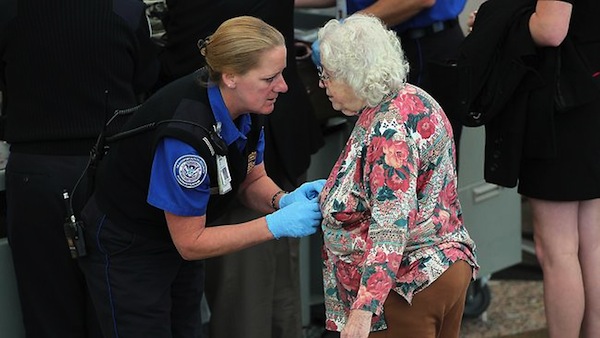
To assert that ethnicity, gender, age, nationality, dress, traveling companions, behavior in the terminal, and other outward appearances offer no indication of a person’s beliefs or terrorist potential is either quite crazy or totally dishonest. We are paying a very high price for this obscurantism—and the price could grow much higher in an instant. We have limited resources, and every moment spent searching a woman like the one pictured above, or the children seen in the videos I linked to in my original article, is a moment in which someone or something else goes unobserved. Suicidal terrorism is overwhelmingly a Muslim phenomenon. It follows that applying equal scrutiny to Mennonites is a dangerous waste of time.
In the hope of achieving some clarity on the issue of profiling, I let the anti-profiling security expert Bruce Schneier write a guest post on my blog. I then engaged in a long and rather tedious debate with him. It seems that few minds were changed, including my own. I heard from many readers who took my side in the debate—among them some who have worked in airport security, U.S. Customs, the FBI, Delta Force, fraud detection, and other areas where real-time threat assessments must be made. I also received unequivocal support from Saudis, Pakistanis, Indians, Egyptians, and others who are regularly profiled. However, I heard as well from many people who thought that Schneier mopped the floor with me. Some of these readers continue to wonder why I, being ostensibly committed to reason, haven’t publicly conceded defeat and changed my view.
There seems to be a consensus, even among my critics, that no one does airline security better than the Israelis (Schneier himself admits this). But, as I pointed out, and Schneier agreed, the Israelis profile in every sense of the term—racially, ethnically, behaviorally, by nationality and religion, etc. In the end, Schneier’s argument came down to a claim about limited resources: He argued that we are too poor (and, perhaps, too stupid) to effectively copy the Israeli approach. That may be true. But pleading poverty and ineptitude is very different from proving that profiling doesn’t work, or that it is unethical, or that the link between the tenets of Islam and jihadist violence isn’t causal.
Schneier’s opposition to profiling had almost nothing to do with the reasons that many people find it controversial. But none of my critics seemed to notice this. Nor did they notice when Schneier conceded that the most secure system would use a combination of profiling and randomness. He simply argued that profiling for the purpose of airline security is too expensive and impractical. But I was not vilified because I advocated something expensive and impractical. I was vilified because my critics believe that I support a policy that is shockingly unethical, well known to be ineffective, and the product of near-total confusion about the causes of terrorism.
My position on profiling is very simple: We should admit that we know what we are looking for (suicidal terrorists) and that certain people obviously require less scrutiny than others. We should scan everyone’s luggage, of course, because bombs can be placed there without a person’s knowledge. But given scarce resources, we can’t afford to waste our time and attention pretending to think that every traveller is equally likely to be affiliated with al Qaeda.
My position on preemptive nuclear war
I mean, Sam Harris, at the end of his first book, asks us to consider a nuclear first strike on the Arab world.
(I don’t believe in atheists, Salon, March 13, 2008)
Sam Harris in his book The End of Faith calls for us to consider a nuclear first-strike on the Arab world. I almost fell out of my chair reading that.
(Q&A at Harvard Divinity School, March 20, 2008)
Harris, echoing the blood lust of Hitchens, calls, in his book The End of Faith, for a nuclear first strike against the Islamic world.
(The Dangerous Atheism of Christopher Hitchens and Sam Harris, Alternet, March 22, 2008)
And you have in Sam Harris’ book, “The End of Faith,” a call for us to consider a nuclear first strike against the Arab world. This isn’t rational. This is insane.
(The Tavis Smiley Show, April 15, 2008)
Sam Harris, in his book The End of Faith, asks us to consider carrying out a nuclear first-strike on the Arab world. That’s not a rational option—that’s insanity.
(A Conversation with Chris Hedges, Free Inquiry, August/September 2008)
Wherever they appear, Hedges’s comments leave the impression that I want the U.S. government to start killing Muslims by the tens of millions. Below I present the only passage I have ever written on the subject of preventive nuclear war and the only passage that Hedges could be referring to in my work (The End of Faith, pp. 128-129). I have taken the liberty of emphasizing some of the words that Hedges chose to ignore:
It should be of particular concern to us that the beliefs of Muslims pose a special problem for nuclear deterrence. There is little possibility of our having a cold war with an Islamist regime armed with long-range nuclear weapons. A cold war requires that the parties be mutually deterred by the threat of death. Notions of martyrdom and jihad run roughshod over the logic that allowed the United States and the Soviet Union to pass half a century perched, more or less stably, on the brink of Armageddon. What will we do if an Islamist regime, which grows dewy-eyed at the mere mention of paradise, ever acquires long-range nuclear weaponry? If history is any guide, we will not be sure about where the offending warheads are or what their state of readiness is, and so we will be unable to rely on targeted, conventional weapons to destroy them. In such a situation, the only thing likely to ensure our survival may be a nuclear first strike of our own. Needless to say, this would be an unthinkable crime—as it would kill tens of millions of innocent civilians in a single day—but it may be the only course of action available to us, given what Islamists believe. How would such an unconscionable act of self-defense be perceived by the rest of the Muslim world? It would likely be seen as the first incursion of a genocidal crusade. The horrible irony here is that seeing could make it so: this very perception could plunge us into a state of hot war with any Muslim state that had the capacity to pose a nuclear threat of its own. All of this is perfectly insane, of course: I have just described a plausible scenario in which much of the world’s population could be annihilated on account of religious ideas that belong on the same shelf with Batman, the philosopher’s stone, and unicorns. That it would be a horrible absurdity for so many of us to die for the sake of myth does not mean, however, that it could not happen. Indeed, given the immunity to all reasonable intrusions that faith enjoys in our discourse, a catastrophe of this sort seems increasingly likely. We must come to terms with the possibility that men who are every bit as zealous to die as the nineteen hijackers may one day get their hands on long-range nuclear weaponry. The Muslim world in particular must anticipate this possibility and find some way to prevent it. Given the steady proliferation of technology, it is safe to say that time is not on our side.
Clearly, I was describing a case in which a hostile regime that is avowedly suicidal acquires long-range nuclear weaponry (i.e. they can hit distant targets like Paris, London, New York, Los Angeles, etc.). Of course, not every Muslim regime would fit this description. For instance, Pakistan already has nuclear weapons, but they have yet to develop long-range rockets, and there is every reason to believe that the people currently in control of these bombs are more pragmatic and less certain of paradise than the Taliban are. The same could be said of Iran, if it acquires nuclear weapons in the near term (though not, perhaps, from the perspective of Israel, for whom any Iranian bomb will pose an existential threat). But the civilized world (including all the pragmatic Muslims living within it) must finally come to terms with what the ideology of groups like the Taliban, al Qaeda, ISIS, etc., means—because it destroys the logic of deterrence. There are a significant number of people in the Muslim world for whom the slogan “We love death more than the infidel loves life” appears to be an honest statement of psychological fact, and we must do everything in our power to prevent them from getting long-range nuclear weapons.
It would seem relevant in this context to note that Chris Hedges has since been exposed as a serial plagiarist and liar—a revelation that I find utterly unsurprising. The truth, however, is that I have met worse than Hedges: There was John Gorenfeld, who interviewed me over the phone (on December 19, 2006) for the website Alternet. I did not respond publicly to the resulting article, because it was so poorly written that I couldn’t imagine anyone taking it seriously. However, it appears to have struck some unsuspecting readers as an honest discussion of my views. So I will simply note my objection to it here. Gorenfeld seriously distorted my positions on two controversial topics—judicial torture and the paranormal—both of which are clarified below.
My views on race, racism, and racial differences
In April of 2017, I published a podcast with Charles Murray, co-author of the controversial (and endlessly misrepresented) book The Bell Curve. The book was an analysis of the cognitive stratification of society, and did not focus on race—but it contained a chapter on race and IQ, the negative response to which fully engulfed Murray’s life.
The most provocative claims in the book amount to the following:
- Human “general intelligence” is a scientifically valid concept.
- IQ tests do a pretty good job of measuring it.
- Differences in IQ are highly predictive of success in the modern world.
- Mean IQ scores differ across populations (blacks < whites < Asians).
- It isn’t known to what degree differences in IQ are genetically determined, but it seems safe to say that genes play a role (and it’s safe to say that the environment does too).
At the time Murray wrote The Bell Curve, these claims were not scientifically controversial—but, taken together, they proved disastrous for his reputation among nonscientists (his co-author, Richard Herrnstein, died before the book was published). When I spoke with Murray in 2017, he had just been de-platformed at Middlebury College, a full quarter century after The Bell Curve was published. As he and his host were leaving the auditorium, they were assaulted by an angry mob of students. The incident ranks among the worst, recent examples of moral panic on the Left, where conservative thinkers—or those who are merely imagined to be conservative—have been silenced. I decided to have Murray on my podcast to discuss the episode, along with the mischaracterizations of his research that gave rise to it.
As it happens, I have very little interest in IQ testing, and no interest at all in racial differences in intelligence. But I am deeply concerned about the free exchange of ideas—and about its suppression by dogmatists and bullies. Needless to say, I knew that having a friendly conversation with Murray might draw some fire my way. That was, in part, the point. Given the viciousness with which he continues to be scapegoated, I felt that it was a moral imperative to give him some cover.
In the aftermath of our conversation, many people have sought to paint me as a racist—but few have shown as much zeal for the project as Ezra Klein, the former editor-in-chief of Vox. In response to my podcast, Klein published an article that pretended to offer the scientific consensus on human intelligence, while vilifying Murray as a racist pseudoscientist and me as, at best, his dupe. More likely, readers unfamiliar with my work came away believing that I’m a racist pseudoscientist as well. Rather than merely take issue with our interpretation of the data, the Vox piece accused Murray and me of the most egregious intellectual misconduct.
After reading this attack, Richard Haier, the editor-in-chief of the journal Intelligence, and the author of the book The Neurobiology of Intelligence, came to our defense, unbidden, with a far more mainstream opinion on the relevant science. And yet Klein refused to publish it. And then he attacked us again, and again. (Haier later published his piece in Quillette. And Andrew Sullivan responded as well.)
After wrangling with Klein on social media and by email, I agreed to do a podcast with him to discuss the controversy that he had manufactured. Many people were thankful that the conversation occurred—though most still found it painful to listen to. It’s yet another bizarre exchange, where two ostensibly smart, morally serious people talk past one another for hours.
There are many ways to see how ethically and intellectually untenable Klein’s position is. For instance, in 2014 it was discovered that most people on earth are 2.7 percent Neanderthal—that is, everyone who isn’t black. When this discovery was first announced, I posted the following on Twitter: “Attention all racists: You were right. Whites are special. We’re part Neanderthal. Blacks are just human.” Apart from giving some indication of my views on race and racism prior to the Murray controversy, the moment reveals a dangerous double standard in the politicization of science. In our podcast, I asked Klein to consider what would have happened if the data had broken the other way, and we discovered that the only people on earth who were part Neanderthal happened to be black. Klein dodged the point, as he dodged most others. But he knows exactly what would have happened in the aftermath of such a discovery. Any scientist or journalist left holding those data when the music stopped would have had their reputation destroyed. Klein appears quite happy with this double standard. Indeed, he is working very hard to enshrine it—and to create an atmosphere in which scientific discourse is riven by lies, hypocrisy, scapegoating, and moral cowardice.
Almost everything we value about ourselves and other people is determined both by genetics and by the environment—and it would be a miracle if every trait we value were identically expressed across all groups. Of course, the concept of “race” is ill-defined and can be misleading. There is, for instance, more genetic diversity among people on the continent of Africa than anywhere else. (The common ancestors for most world populations can be found around 50,000 years ago. However, some African groups have been effectively separated for 200,000 years.) Are there many “races” there? Not according to anyone who believes that skin color is the primary signifier of group identity. The truth, however, is that however one defines “race”—whether by reference to polygenetic variations in specific groups, revealing their distinct ancestry, or merely by how modern people “self identify” across census categories—there are likely to be average group differences in traits we care about. This will be true for things like susceptibility to diabetes and prostate cancer, but it is also likely to be true for cognitive, emotional, and behavioral traits as well.
If, for example, we discover all the genetic and environmental factors that determine a person’s propensity for violence, the probability that these factors will be set at precisely the same levels among Norwegians, Japanese, Inuit, Fijians, Masai, etc., is essentially zero. And if, by some miracle, a propensity for violence were identical across all groups, some other important trait will be heavily skewed. Do Americans who believe that their ancestors were “French” and those who believe their ancestors were “Chinese” have the same average height? Almost certainly not. Do they have the same average IQ? Don’t bet on it. Yes, people with high and low values for any trait will be found in every group—and so the variance between individuals will exceed the variance between groups—but nontrivial differences between population averages will also be found. However we study the biological and cultural contributions to our humanity, we will be ambushed by evidence of group differences that will seem—or can be made to seem—politically invidious. The answer to this pseudo problem isn’t to lie about facts and to defenestrate anyone who won’t lie on cue. The answer is to treat people as individuals and reaffirm our commitment to political equality. Our ongoing efforts to create the best possible world cannot depend upon lies.
To reiterate, I did not have Murray on my podcast because I’m interested in racial difference—whether in IQ or in any other trait. I spoke to Murray because I believed that I had witnessed an honest scholar pilloried and shunned for decades. I’d also heard from many prominent scientists who thought that Murray had been treated despicably, but who didn’t have the courage to say so publicly. And their silence bothered me. In fact, every scientist I spoke with about Murray felt that a grave injustice had been done in his case. So I invited him on the podcast. And in order to demonstrate that he’s not a malicious charlatan and a racist, I was obliged to discuss the relevant science. This is the science that Klein calls “racialist pseudoscience” and “America’s most ancient justification for bigotry and racial inequality.” But it’s just science. And people of good will can speak about it honestly, without losing their commitment to political equality.
On May 25, 2018, I released audio from an event I did with Christian Picciolini in Dallas. Picciolini is the former leader of the neo-Nazi gang, Hammerskin Nation, and appears to have spent many years living like a character out of Clockwork Orange. He later turned himself around and became a deprogrammer of white supremacists. Unfortunately, Picciolini said a few things in our podcast that don’t seem to have been true, and I later heard from two people who considered his remarks defamatory. The first was James Damore, the author of the infamous “Google memo.” Picciolini had described Damore as member of the “alt-Right,” to the surprise and consternation of many in our Dallas audience. The second was Stefan Molyneux, a Canadian YouTuber with a very large following. Picciolini made two claims about Molyneux that drew protest. He alleged that he is a “Holocaust denier.” (Denying the Holocaust is actually illegal in Canada, so Picciolini was technically accusing him of a crime.) Picciolini also said that Molyneux had a connection to David Duke, the former Grand Wizard of the KKK.
While I didn’t know enough about Damore or Molyneux to challenge Picciolini’s claims on stage, I didn’t endorse them, and when we got pushback from the audience, I said that I didn’t know enough to fact check these statements in real time. However, I later came to believe that each of these specific claims were false. Picciolini just seemed flat wrong about Damore (and he later admitted as much by email). As for Molyneux, I don’t doubt that there are many things that one could criticize the man for—he really does appear inordinately concerned about racial differences. However, I later spoke to Molyneux on the phone, after receiving a letter from his attorney, and it was clear from our conversation that Picciolini’s two, specific charges against him were false. Molyneux accepts mainstream historical accounts about the Holocaust—and accepting this history is tantamount to disproving any charge of “Holocaust denial.” He also assured me that he had never spoken to or otherwise communicated with David Duke. It seems that Duke had merely retweeted something he wrote, and Picciolini took this to mean that the two men had formed an alliance. If we’re all culpable for everyone who retweets us, no one will escape hanging.
I reached out to Picciolini to see if he could produce evidence to substantiate his claims, but he could not. In place of evidence, he provided links to other material suggesting that Molyneux is a creep—but nothing that spoke to the issue of “Holocaust denial” or that suggested an association with Duke. When I observed how unsatisfactory the evidence was, Picciolini went nuts, and began castigating me as an enabler of white supremacy. Which is a peculiar charge, given that I had him on my podcast to discuss the dangerous idiocy of white supremacy.
In light of these developments, I decided to edit the original podcast and remove the false allegations. I also apologized to James Damore and Stefan Molyneux for whatever hassle the original audio had caused them. As should be clear, this damage control wasn’t an endorsement of anything these men had said or done (or have said or done since). In fact, I still don’t know much more about Damore and Molyneux than I did when I was sitting on stage with Picciolini in Dallas. But few things are more odious than spreading derogatory misinformation about people, whatever their views.
I suppose it’s not much of a surprise that a man who once ran the largest neo-Nazi gang in the United States might have a few, lingering character flaws. But I remain fairly amazed by Picciolini’s behavior. More than a year has passed, and he continues to attack me in public and private—in fact, he has even tried to get me disinvited from speaking engagements. Needless to say, I hope to pick my podcast guests more carefully in the future.
My position on torture
In The End of Faith, I argue that competing religious doctrines have divided our world into separate moral communities and that these divisions have become a continual source of human violence. My purpose in writing the book was to offer a way of thinking about our world that would render certain forms of conflict quite literally unthinkable.
In one section of the book (pp. 192−199), I briefly discuss the ethics of torture and collateral damage in times of war, arguing that collateral damage is worse than torture across the board. Rather than appreciate just how bad I think collateral damage is in ethical terms, some readers have mistakenly concluded that I take a cavalier attitude toward the practice of torture. I do not. Nevertheless, there are extreme circumstances in which I believe that practices like “water-boarding” may be not only ethically justifiable, but ethically necessary. This is not the same as saying that they should be legal (Crimes such as trespassing and theft may sometimes be ethically necessary, though everyone has an interest in keeping them illegal).
I am not alone in thinking that there are potential circumstances in which the use of torture would be ethically justifiable. The liberal Senator Charles Schumer has publicly stated that most U.S. senators would support torture to find out the location of a ticking time bomb. Such scenarios have been widely criticized as unrealistic. But realism is not the point of these thought experiments. The point is that unless your argument rules out torture in idealized cases, you don’t have a categorical argument against torture. As nuclear and biological terrorism become increasingly possible, it is in everyone’s interest for men and women of goodwill to determine what should be done if a person appears to have operational knowledge of an imminent atrocity (and may even claim to possess such knowledge), but won’t otherwise talk about it.
My argument for the limited use of coercive interrogation (“torture” by another name) is essentially this: If you think it is ever justifiable to drop bombs in an attempt to kill a man like Osama bin Laden (and thereby risk killing and maiming innocent men, women, and children), you should think it may sometimes be justifiable to water-board a man like Osama bin Laden (and risk abusing someone who just happens to look like him). It seems to me that however one compares the practices of water-boarding high-level terrorists and dropping bombs, dropping bombs always comes out looking worse in ethical terms. And yet, most people tacitly accept the practice of modern warfare while considering it taboo to even speak about the possibility of practicing torture. It is important to point out that my argument for the restricted use of torture does not make a travesty like Abu Ghraib look any less sadistic or stupid. I consider our mistreatment of prisoners at Abu Ghraib to be patently unethical. I also think it was one of the most damaging blunders in the last century of U.S. foreign policy. Nor have I ever seen the wisdom or necessity of denying proper legal counsel (and access to evidence) to prisoners held at Guantánamo Bay. Indeed, I consider much of what occurred under Bush and Cheney—the routine abuse of ordinary prisoners, the practice of “extraordinary rendition,” etc.—to be a terrible stain upon our nation.
Some people believe that while collateral damage may be worse than torture, they are independent evils, and one problem sheds no light upon the other. However, they are not independent in principle. In fact, it is easy to see how information gained through torture might mitigate the risk of collateral damage. If one found oneself with an apparent choice between torturing a known terrorist and bombing civilians, torturing the terrorist should seem like the more ethical option. But most people’s intuitions seem to run the other way. In fact, very few critics of my collateral-damage argument even acknowledge how strangely asymmetrical our worries about torture and collateral damage are. A conversation about the ethics of torture can scarcely be had, and yet collateral damage is often reported in the context of a “successful” military operation as though it posed no ethical problem whatsoever. The case of Baitullah Mehsud, killed along with 12 others (including his wife and mother-in-law), is a perfect example: Had his wife been water-boarded in order to obtain the relevant intelligence, rather than merely annihilated by a missile, we can be sure that torrents of outrage would have ensued.
It seems, in fact, that many people do not understand what the phrase “collateral damage” signifies, and thus they imagine that I have drawn a false analogy. Most assume that my analogy fails because torture is the intentional infliction of guaranteed suffering, whereas collateral damage is the unintentional imposition of possible suffering (or death). Apples and oranges.
But this isn’t true. We often drop bombs knowing that innocent people will be killed or horribly injured by them. We target buildings in which combatants are hiding, knowing that noncombatants are also in those buildings, or standing too close to escape destruction. And when innocent people are killed or injured—when children are burned over most of their bodies and live to suffer interminable pain and horrible disfigurement—our leaders accept this as the cost of doing business in a time of war. Many people oppose specific wars, of course—such as the war in Iraq—but no public figure has been vilified for accepting collateral damage in a war that is deemed just. And yet, anyone who would defend the water-boarding of a terrorist like Khalid Sheikh Muhammad will reap a whirlwind of public criticism. This makes no moral sense.
Again, which is worse: water-boarding a terrorist or killing/maiming him? Which is worse, water-boarding an innocent person or killing/maiming him? There are journalists who have volunteered to be water-boarded. Where are the journalists who have volunteered to have a 5000-pound bomb dropped on their homes with their families inside?
It is widely claimed that torture “does not work”—that it produces unreliable information, implicates innocent people, etc. As I argue in The End of Faith, this line of defense does not resolve the underlying ethical dilemma. The claim that torture never works, or that it always produces bad information, is incredible (and well known to be false). There are cases in which the mere threat of torture has worked. One can easily imagine situations in which even a very low probability of getting useful information through torture would seem to justify it—the looming threat of nuclear terrorism being the most obvious case. It is decidedly unhelpful that those who claim to know that torture is “always wrong” never seem to envision the circumstances in which good people would be tempted to use it. Critics of my collateral-damage argument always ignore the hard case: when the person in custody is known to have been involved in terrible acts of violence and when the threat of further atrocities is imminent. If you think such situations never arise, consider what it might be like to capture a high-ranking member of al Qaeda along with several accomplices and their computers. The possibility that such a person might really be “innocent” or that he could “just say anything” to mislead his interrogators begins to seem less of a concern. Such captures bring us closer to a “ticking-bomb” scenario than many people are willing to admit.
Although I think that torture should remain illegal, it is not clear that having a torture provision in our laws would create as slippery a slope as many people imagine. We have a capital punishment provision, but it has not led to our killing prisoners at random because we can’t control ourselves. While I am strongly opposed to capital punishment, I can readily concede that our executing about five people every month hasn’t led to total moral chaos. Perhaps a rule regarding torture could be applied with equal restraint.
It seems probable, however, that any legal use of torture would have unacceptable consequences. In light of this concern, the best strategy I have heard comes from Mark Bowden in his Atlantic Monthly article “The Dark Art of Interrogation.” Bowden recommends that we keep torture illegal and maintain a policy of not torturing anybody for any reason—but our interrogators should know that there are certain circumstances in which it would be ethical to break the law. Indeed, there are circumstances in which you would have to be a monster not to break the law. If an interrogator found himself in such a circumstance and broke the law, there would be little will to prosecute him (and interrogators would know this). If he broke the law Abu Ghraib-style, he will go to prison for a very long time (and interrogators would know this too). At the moment, this seems like the most reasonable policy to me.
The best case against “ticking-bomb” arguments appears in David Luban’s article, “Liberalism, Torture, and the Ticking Bomb,” published in the Virginia Law Review. Luban relies on a few questionable assumptions, however. And he does not actually provide an ethical argument against torture in the ticking-bomb case; he offers a pragmatic argument against our instituting a policy allowing torture in such cases. There is absolutely nothing in Luban’s argument that rules out the following law:
We will not torture anyone under any circumstances unless we are certain, beyond all reasonable doubt, that the person in our custody has operational knowledge of an imminent act of nuclear terrorism.
It seems to me that unless one can produce an ethical argument against torturing such a person, one does not have an argument against the use of torture in principle. Of course, my discussion of torture in The End of Faith (and on this page) addresses only the ethics of torture—not the practical difficulties of implementing a policy based on the ethics.
Many readers have found my views on this topic deeply unsettling. I do too. It would be much easier to simply be “against torture” across the board and end the discussion. I have invited readers, both publicly and privately, to produce an ethical argument that takes into account the realities of our world—our daily acceptance of collateral damage, the real possibility of nuclear terrorism, etc.—and yet rules out a practice like water-boarding in all conceivable circumstances. No one, to my knowledge, has done this. And yet, most people continue to speak and write as though a knockdown argument against torture in all circumstances were readily available. I consider it to be one of the more dangerous ironies of liberal discourse that merely discussing the possibility of torturing a man like Osama bin Laden provokes more outrage than the maiming and murder of children ever does. Until someone actually points out what is wrong with the collateral-damage argument presented in The End of Faith, I will continue to believe that its critics are just not thinking clearly about the reality of human suffering.
(For what it’s worth, I have since discovered that the Stanford Encyclopedia of Philosophy basically takes the same view.)
My discussion of killing people “for what they believe” (pp. 52-53 in The End of Faith)
The link between belief and behavior raises the stakes considerably. Some propositions are so dangerous that it may even be ethical to kill people for believing them. This may seem an extraordinary claim, but it merely enunciates an ordinary fact about the world in which we live. Certain beliefs place their adherents beyond the reach of every peaceful means of persuasion, while inspiring them to commit acts of extraordinary violence against others. There is, in fact, no talking to some people. If they cannot be captured, and they often cannot, otherwise tolerant people may be justified in killing them in self-defense. This is what the United States attempted in Afghanistan, and it is what we and other Western powers are bound to attempt, at an even greater cost to ourselves and to innocents abroad, elsewhere in the Muslim world. We will continue to spill blood in what is, at bottom, a war of ideas.
This paragraph appears after a long discussion of the role that belief plays in governing human behavior, and it should be read in that context. Some critics have interpreted the second sentence of this passage to mean that I advocate simply killing religious people for their beliefs. Granted, I made the job of misinterpreting me easier than it might have been, but such a reading remains a frank distortion of my views. To someone reading the passage in context, it should be clear that I am discussing the link between belief and behavior. The fact that belief determines behavior is what makes certain beliefs so dangerous.
When one asks why it would be ethical to drop a bomb on Ayman al-Zawahiri, the current leader of al Qaeda, the answer cannot be, “Because he killed so many people in the past.” To my knowledge, the man hasn’t killed anyone personally. However, he is likely to get a lot of innocent people killed because of what he and his followers believe about jihad, martyrdom, the ascendancy of Islam, etc. A willingness to take preventative action against a dangerous enemy is compatible with being against the death penalty (which I am). Whenever we can capture and imprison jihadists, we should. But in many cases this is either impossible or too risky. Would it have been better if we had captured Osama bin Laden? In my view, yes. Do I think the members of Seal Team Six should have assumed any added risk to bring him back alive? Absolutely not.
My position on the war in Iraq
I have never written or spoken in support of the war in Iraq. This has not stopped a “journalist” like Glenn Greenwald from castigating me as a warmonger (Which is especially rich, given that he supported the war. In fact, in 2005 he appeared less critical of U.S. foreign policy than I am.) The truth is, I have never known what to think about this war, apart from the obvious: 1) prospectively, it seemed like a very dangerous distraction from the ongoing war in Afghanistan; 2) retrospectively, it was a disaster. Much of the responsibility for this disaster falls on the Bush administration, and one of the administration’s great failings was to underestimate the religious sectarianism of the Iraqi people. Whatever one may think about the rationale for invading Iraq and the prosecution of the war, there is nothing about the conflict that makes Islam look benign—not the reflexive solidarity expressed throughout the Muslim world for Saddam Hussein (merely because an army of “infidels” attacked him), not the endless supply of suicide bombers willing to kill Iraqi noncombatants, not the insurgency’s use of women and children as human shields, not the ritual slaughter of journalists and aid workers, not the steady influx of jihadis from neighboring countries, and not the current state of public opinion among European and American Muslims. It seems to me that no reasonable person can conclude that these phenomena are purely the result of U.S. foreign policy.
My views on rape
I don’t harbor any controversial views about rape, but several malicious people have worked very hard to make it seem as though I do. Rape is evil, and I believe it should be judged extraordinarily harshly by any civilized society. However, I’ve said a few things that, lifted out of context, can be spun to make it seem as though I don’t consider rape to be a serious crime. For instance, I once said in an interview that “If I could wave a magic wand and get rid of either rape or religion, I would not hesitate to get rid of religion.”
Here is the context:
Saltman: Isn’t religion a natural outgrowth of human nature?
Harris: It almost certainly is. But everything we do is a natural outgrowth of human nature. Genocide is. Rape is. No one would ever think of arguing that this makes genocide or rape a necessary feature of a civilized society. Even if you had a detailed story about the essential purpose religion has served for the past fifty thousand years, even if you could prove that humanity would not have survived without believing in a creator God, that would not mean that it’s a good idea to believe in a creator God now, in a twenty-first-century world that has been shattered into separate moral communities on the basis of religious ideas. Traditionally, religion has been the receptacle of some good and ennobling features of our psychology. It’s the arena in which people talk about contemplative experience and ethics. And I do think contemplative experience and ethics are absolutely essential to human happiness. I just think we now have to speak about them without endorsing any divisive mythology.
Saltman: Your analogy between organized religion and rape is pretty inflammatory. Is that intentional?
Harris: I can be even more inflammatory than that. If I could wave a magic wand and get rid of either rape or religion, I would not hesitate to get rid of religion. I think more people are dying as a result of our religious myths than as a result of any other ideology. I would not say that all human conflict is born of religion or religious differences, but for the human community to be fractured on the basis of religious doctrines that are fundamentally incompatible, in an age when nuclear weapons are proliferating, is a terrifying scenario. I think we do the world a disservice when we suggest that religions are generally benign and not fundamentally divisive.
It is, of course, an empirical question whether “more people are dying as a result of our religious myths than as a result of any other ideology.” I’m not sure whether I believe that this is true in the year 2019, but I certainly believed it in 2006. In any case, I remain confident that the enormity of unnecessary bigotry, violence, political oppression, and psychological misery—and, indeed, the vast number of rapes—directly attributable to religion make my original statement easy to defend. And these harms are in no way offset by the many good things people get from religion—community, spirituality, ethics, etc.—which can be had directly, at no cost to our understanding of the world or of one another. My comments, in this context, were meant to convey just how bad I think religion is, not that I take the crime of rape lightly. For instance, I worry that jihadists will one day detonate crude nuclear bombs in major cities, killing hundreds of thousands of people and deranging human history for an entire generation (causing billions to suffer and many millions more to die). This scenario doesn’t seem at all far fetched, and magically ridding the world of religion would close the door to it. It would also end the epidemic of child rape in the Catholic Church, rape as a tool of war (in the such cases where its purpose is to exploit the religious taboos of the victimized community), along with sexual enslavement (more rape) of non-Muslim women by groups like the Islamic State. Indeed, the list of harms that I attribute directly to religion can be extended indefinitely, subsuming innumerable instances of rape along the way. Needless to say, those who circulate the abbreviated, inflammatory quotation to make me look like a rape apologist understand this.
As above, I also reference rape to illustrate the vast gulf between what is “natural” and what is “good.” Here is how I put it in my second book, Letter to a Christian Nation (pp. 90-91):
As a biological phenomenon, religion is the product of cognitive processes that have deep roots in our evolutionary past. Some researchers have speculated that religion itself may have played an important role in getting large groups of prehistoric humans to socially cohere. If this is true, we can say that religion has served an important purpose. This does not suggest, however, that it serves an important purpose now. There is, after all, nothing more natural than rape. But no one would argue that rape is good, or compatible with a civil society, because it may have had evolutionary advantages for our ancestors. That religion may have served some necessary function for us in the past does not preclude the possibility that it is now the greatest impediment to our building a global civilization.
As should be clear, I was hoping to close the door to the specious claim that, just because a behavior might have proved adaptive in the past (in that it allowed our ancestors to successfully spread their genes), we should venerate it in the present. Again, my words in context do not suggest that I view rape as anything less than evil. However, certain of my “critics” have decided to spread my thoughts on the topic this way:
“There is nothing more natural than rape.” — Sam Harris
I hope I never grow so cynical as to get used to this behavior.
My views on the paranormal: ESP, reincarnation, etc.
My position on the paranormal is this: Although many frauds have been perpetrated in the history of parapsychology, I believe that this field of study has been unfairly stigmatized. If some experimental psychologists want to spend their days studying telepathy, or the effects of prayer, I will be interested to know what they find out. And if it is true that toddlers occasionally start speaking in ancient languages (as Ian Stevenson alleged), I would like to know about it. However, I have not attempted to authenticate the data put forward in books such as Dean Radin’s The Conscious Universe and Ian Stevenson’s 20 Cases Suggestive of Reincarnation. The fact that I have not spent any time on this should suggest how worthy of my time I think such a project would be. Still, I found these books interesting, and I cannot categorically dismiss their contents in the way that I can dismiss the claims of religious dogmatists. (Here, I am making a point about gradations of certainty: Can I say for certain that a century of experimentation proves that telepathy doesn’t exist? No. It seems to me that reasonable people can disagree about the statistical data. Can I say for certain that the Bible and the Qur’an show every sign of having been written by ignorant mortals? Yes. And this is the only certainty one needs to dismiss the God of Abraham as a creature of fiction.)
While I remain open to evidence of psi phenomena—clairvoyance, telepathy, and so forth—the fact that they haven’t been conclusively demonstrated in the lab is a very strong indication that they do not exist. Researchers who study these things allege that the data are there and that proof of psi can be seen in departures from randomness that occur over thousands of experimental trials. But people who believe in psi aren’t thinking in terms of weak, statistical effects. They believe that a specific person can reliably read minds, heal the sick, and work other miracles. I have yet to see a case in which evidence for such abilities was presented in a credible way. If one person on earth possessed psychic powers to any significant degree, this would be among the easiest facts to authenticate in a lab. Many people have been duped by traditional evasions on this point; it is often said, for instance, that demonstrating such powers on demand would be spiritually uncouth and that even to want such empirical evidence is an unflattering sign of doubt on the part of a student. Except ye see signs and wonders, ye will not believe (John 4:48). A lifetime of foolishness and self-deception awaits anyone who won’t call this bluff.
My views on Eastern mysticism, Buddhism, etc.
My views on “mystical” or “spiritual” experience are extensively described in my book Waking Up: A Guide to Spirituality Without Religion and in the Waking Up Course. Nothing I believe in this area is based on faith. There is simply no question that people have transformative experiences as a result of engaging in disciplines like meditation, and these experiences obviously shed some light on the nature of the human mind. (Any experience does, for that matter). The metaphysical claims that people tend to make on the basis of these experiences, however, are highly questionable. I do not make any such claims. Nor do I support the metaphysical claims of others.
Several neuroscience labs are now studying the effects of meditation on the brain. I’m not personally engaged in this research, but I know many of the scientists who are. This is a fertile area of inquiry that is deepening our understanding of human well-being.
While I consider Buddhism to be almost unique among the world’s religions as a repository of contemplative wisdom, I do not consider myself a Buddhist. My criticism of Buddhism as a faith has been published, to the consternation of many Buddhists. It is available here: